
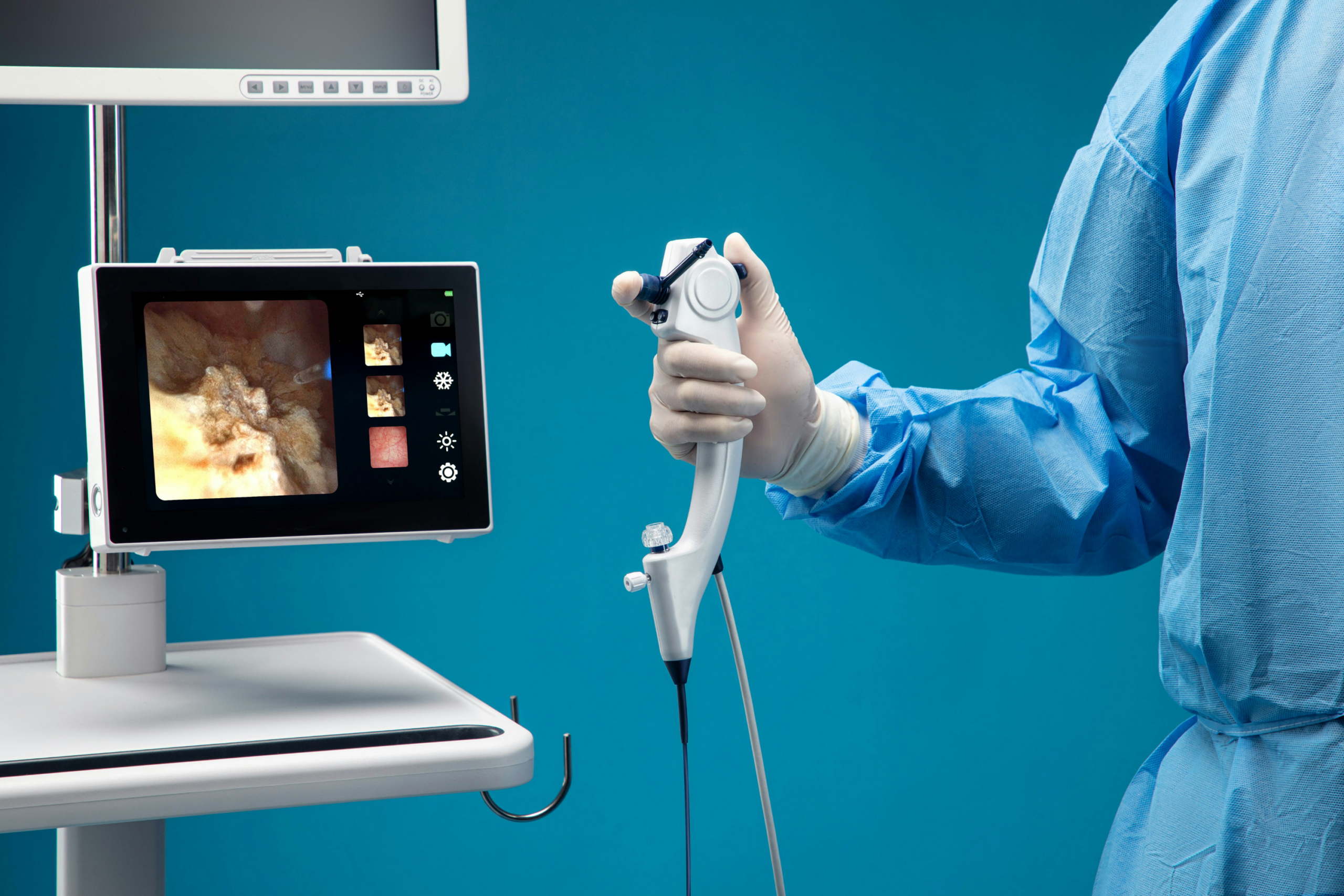
The term “camera-assisted surgery” is often used by surgical patients to refer to modern surgical procedures performed using a miniature camera. But how do these surgical procedures actually work? And what role do video management systems play in these procedures?
What exactly is a camera-assisted surgery?
A camera-assisted surgery is a form of minimally invasive or video-assisted surgery. Unlike traditional open surgery, the surgeon does not need to make a large incision to access the area to be treated.
Instead, a miniature camera is inserted into the body through a small incision or a natural orifice. The images are transmitted in real time to medical monitors, allowing the surgeon to see the inside of the body in detail and guide his instruments with great precision.
This technology is now the standard in many surgical specialties.
How does a camera-assisted surgery work?
A camera-assisted procedure is performed as follows:
- A medical camera is inserted into the patient's body.
- Video is recorded in Full HD quality, or even 4K, depending on the video recorder.
- They are displayed instantly on the operating room screens.
- The surgeon performs the procedure while viewing these images in real time.
The camera essentially becomes the surgeon's eyes. It provides the surgeon with a detailed view of anatomical structures that are sometimes difficult to see with the naked eye.
Thanks to advances in video technology, it is now possible to capture Full HD, 4K, and even 3D images that offer an exceptional level of detail.
What are the main types of camera-assisted surgeries?
Several surgical techniques use this video visualization principle:
Laparoscopy
Used for abdominal and pelvic procedures, it allows surgeons to operate through a few small incisions measuring only a few millimeters.
Arthroscopy
This technique is used to examine and treat joints, particularly the knee, shoulder, or ankle.
Operative Endoscopy
It allows surgeons to perform procedures on various organs through natural openings, without making a large external incision.
Robotic Surgery
In this case, the camera provides an extremely detailed view of the surgical field, and the instruments are controlled by the surgeon via a video management system.
What are the benefits for the patient?
The success of video-assisted procedures is due to their many benefits:
- Smaller incisions
- Less postoperative pain
- A reduction in the risk of infection
- Faster recovery
- Reduced scarring
- A shorter hospital stay in many cases
These advantages explain why minimally invasive surgery has become so widespread in hospitals and clinics around the world.
Why has image quality become so important?
When a surgeon works from a screen, image quality becomes a critical factor.
Higher resolution allows for:
- To make it easier to identify anatomical structures
- To improve the precision of movements
- To reduce eye strain
- To facilitate collaboration among members of the surgical team
Modern medical imaging systems now provide ultra-high-definition images capable of revealing details that were sometimes invisible with previous generations of equipment.
What is the role of video management in a camera-based operation?
A camera-assisted procedure does not rely solely on the camera itself. In a modern operating room, multiple image sources can be used simultaneously:
- Endoscopic cameras
- Conference Room Cameras (PTZ)
- Medical Imaging
- Ultrasound Machines
- Surgical robots
- Patient Monitors
The video management allows you to collect, centralize, display, distribute, record, and share all of these video streams from a single interface.
Thanks to this centralization:
- The surgeon has access to the right images at the right time
- Teams collaborate more easily
- Presentations can be recorded
- Images can be stored in the patient's file
- Procedures can be broadcast for training or remote consultation purposes
Today, video management serves as the true digital backbone of the integrated operating room.
The Future of Camera-Based Operations
Video-assisted procedures continue to evolve thanks to the advent ofartificial intelligence, robotic surgery, 4K and 3D cameras, and secure video-sharing solutions. The goal remains the same: to provide surgeons with better visibility, improve patient safety, and optimize the quality of care. In this transformation, video management technologies play a central role by enabling the full utilization of the wealth of visual data produced in the operating room.